
A gutter leak often starts small. Perhaps you might notice a steady drip near a corner or water running down the fascia during heavy rain. In many cases, the problem comes from an old sealed seam that has started letting water through again. Although gutter sealant is designed to close gaps and keep water inside the system, it does not last forever. Weather exposure, temperature changes, movement in the gutter system, and even previous gutter repairs can affect how long a sealed joint remains watertight. Let’s explore why gutter sealant failure happens and what you can do to address the actual leak problem.
- What Gutter Sealant Is Supposed to Do
- Why Gutter Sealant Fails Over Time
- Why Adding More Sealant Does Not Always Fix the Problem
- Creating a Longer-Lasting Gutter Repair
What Gutter Sealant Is Supposed to Do
Gutter sealant is designed to create a watertight barrier in places where separate gutter components meet. Professional gutter installers commonly use it around joints, corners, end caps, downspout outlets, fastener penetrations, and other areas where water could escape through small openings. When properly applied, the sealant fills minor gaps and helps prevent rainwater from leaking behind the gutter or dripping onto siding, fascia boards, walkways, and landscaping. Because gutters regularly hold and direct large amounts of water, even a very small opening can eventually become noticeable during a heavy storm.
Sealant is particularly important if you have older sectional Muskegon gutters. These gutter systems are assembled from multiple pieces, and every place where two sections meet creates another seam that can eventually become a leak point. Unlike traditional sectional gutters, seamless gutters have fewer joints along gutter runs because each section is formed as one continuous piece of material, though the corners, end caps, outlets, and other connections still need to be sealed. Deteriorating sealant at these points might be the reason leaks begin appearing as your gutter system ages.
Why Gutter Sealant Fails Over Time
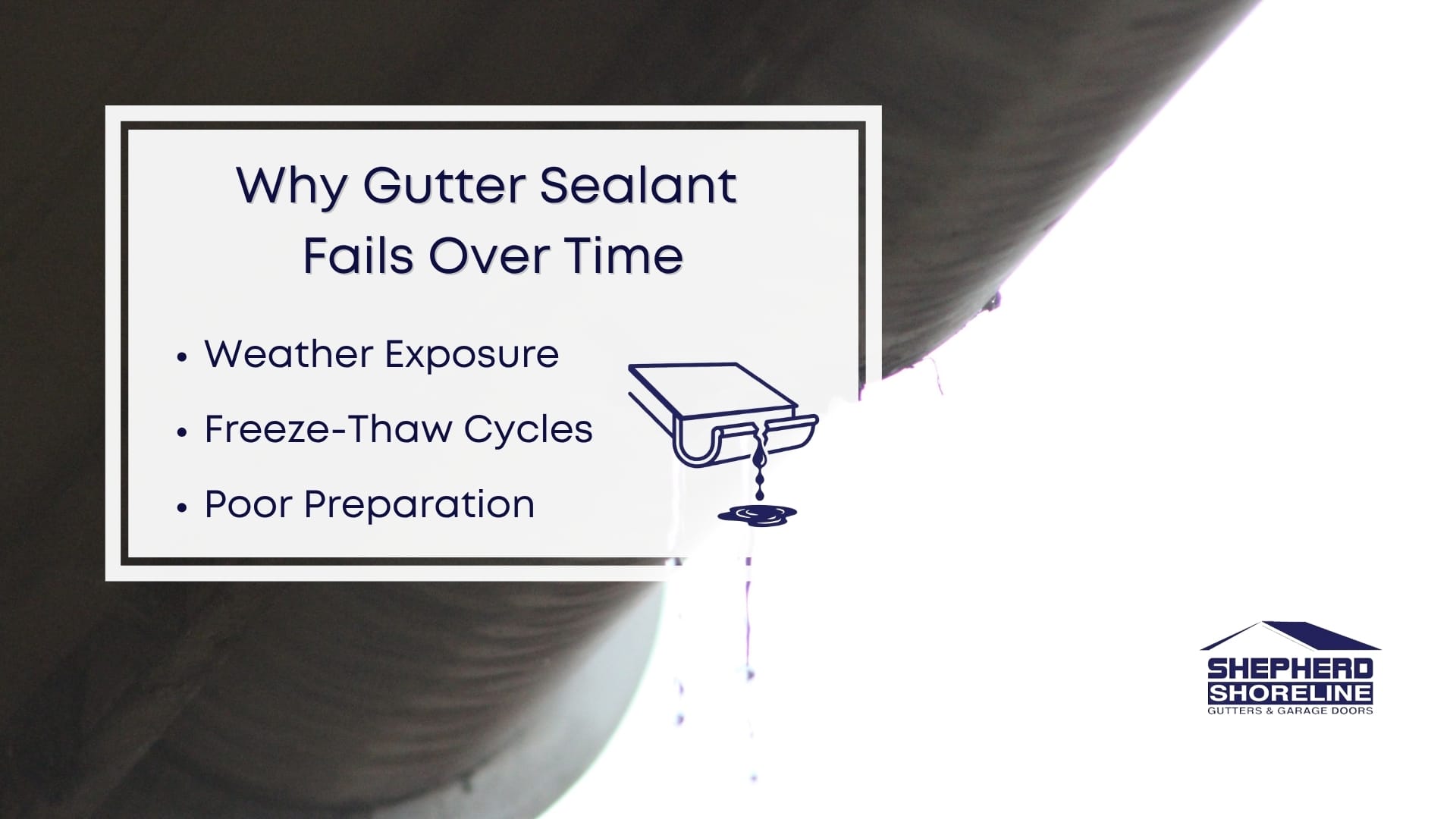
Gutter sealant does not remain unchanged forever. It has to withstand sun, moisture, temperature swings, and physical movement year after year. Several conditions can gradually weaken the material until water starts passing through the joint again.
Weather Exposure
Gutter sealant is exposed to the elements every day. Sunlight, rain, snow, moisture, and temperature changes can slowly alter its flexibility and adhesion. Material that was once soft enough to move with the gutter can eventually become hard, brittle, or cracked. Small cracks might allow water to work underneath the sealant and weaken the bond even further. Once that happens, the leak might gradually spread along the joint.
Freeze-Thaw Cycles
Michigan weather can be particularly hard on gutter seams. Water can settle into tiny cracks or gaps around a joint and freeze when temperatures fall. Because water expands as it freezes, that process can put pressure on the surrounding sealant. When temperatures rise, the ice melts, and the joint relaxes again. Such freeze-thaw cycles can enlarge small openings and eventually break the seal between gutter sections.
Poor Preparation
Some leaks return quickly because the joint was not prepared correctly during an earlier repair. Applying sealant over dirt, oxidation, moisture, loose material, or remnants of old sealant can prevent the new material from bonding properly. Even a high-quality gutter sealant can fail if the surface underneath it is contaminated. A rushed repair might appear successful at first but begin leaking again after a few heavy rains.
Why Adding More Sealant Does Not Always Fix the Problem
When you discover a leaking gutter seam, applying another layer of sealant might appear to be the easiest solution. Sometimes resealing the area works, but applying new material directly over an old repair can produce only temporary results. Fresh sealant might not bond properly to hardened sealant, dirt, moisture, corrosion, or other contaminants. If the original material is already separating from the gutter, covering it does not restore the damaged bond underneath. The new layer might eventually loosen along with the old one, bringing the leak back.
A repeated leak can further indicate that the joint itself is moving or damaged. Loose gutter fasteners, misaligned sections, sagging gutters, or bent metal can place continuous stress on the seam. In these situations, gutter sealant failure is often a symptom rather than the main problem. If two sections keep pulling apart, no amount of additional sealant can permanently correct the movement. Persistent leaks at the same location might mean the seam needs to be cleaned, repositioned, reinforced, repaired, or replaced instead of simply covered again.
Creating a Longer-Lasting Gutter Repair
A reliable gutter repair usually begins by addressing the condition of the joint before applying new material. Loose or failed sealant must be removed so the replacement can bond directly to a stable surface. The area should then be cleaned of dirt, residue, loose corrosion, and other contaminants and allowed to dry as required by the sealant being used. Just as important, any structural problem should be corrected before resealing. If the gutter is sagging, pulling away from the fascia, or sitting out of alignment, repairing those conditions can reduce movement at the seam and give the new sealant a better chance of lasting.
If the same seams keep leaking or several areas of your gutter system are beginning to fail, a professional inspection can help determine whether individual repairs are still practical. Shepherd Shoreline can inspect your gutters, identify the cause of repeated leaks, and recommend an appropriate repair or replacement solution based on the condition of the system. Our competent Muskegon gutter professionals can address damaged seams, alignment problems, deteriorated sections, and other issues that might be contributing to water leakage. Contact us today at (231) 780-2847 or here to have your gutters evaluated.