

When your Coopersville home has gutters and downspouts, you might assume that you’re safe from water problems. After all, these systems are designed to catch rainwater off your roof and carry it away. But many homeowners still deal with wet basements, soggy crawl spaces, puddling along the foundation, or water creeping into the garage, even when the gutter system looks fine. That’s frustrating, and it can get expensive fast, especially when repeated moisture starts to compromise the structural integrity of your foundation.
- The Difference Between Surface Water and Subsurface Water
- How Surface Water Causes Flooding Even With Gutters Installed
- How Subsurface Water Creates Hidden Flooding Problems
- Warning Signs Your Flooding Issue Is Not a Gutter Problem
- Get a Professional Drainage Assessment From Shepherd Shoreline
The truth is, gutters and downspouts only solve part of the issue. Flooding can still happen when water moves across the surface of your yard the wrong way, or when it builds up under the ground and presses against your foundation from below. If you don’t know which kind of water is causing your issue, you might keep fixing the wrong thing and still end up with the same leaks every time it rains. Let’s explore how surface water and subsurface water behave differently and why that difference matters for preventing flooding.
The Difference Between Surface Water and Subsurface Water
Surface water vs. subsurface water comes down to where the water is traveling. Surface water is rainwater that flows over the ground. Think of it as runoff that moves downhill across your lawn, driveway, patio, or landscaping. It’s visible when it collects in low spots, forms puddles, or rushes along the edge of your home during heavy rain. In contrast, subsurface water is water moving through the soil underground. It can be water held in the soil after long rain or water that slowly migrates through saturated ground toward the lowest point, often your basement walls or the area beneath your slab.
Gutters are built to manage roof runoff, which is only one source of surface water, but don’t stop water that’s already on the ground from flowing toward your foundation, and definitely don’t relieve underground pressure from subsurface water. Many homeowners treat every flooding problem as a gutter issue, but often miss what’s really happening. The yard might be directing water to the house, the soil might be holding water, or groundwater might be pushing against the foundation. That misunderstanding is why some homes keep flooding even after gutters are cleaned, upgraded, or replaced.
How Surface Water Causes Flooding Even With Gutters Installed
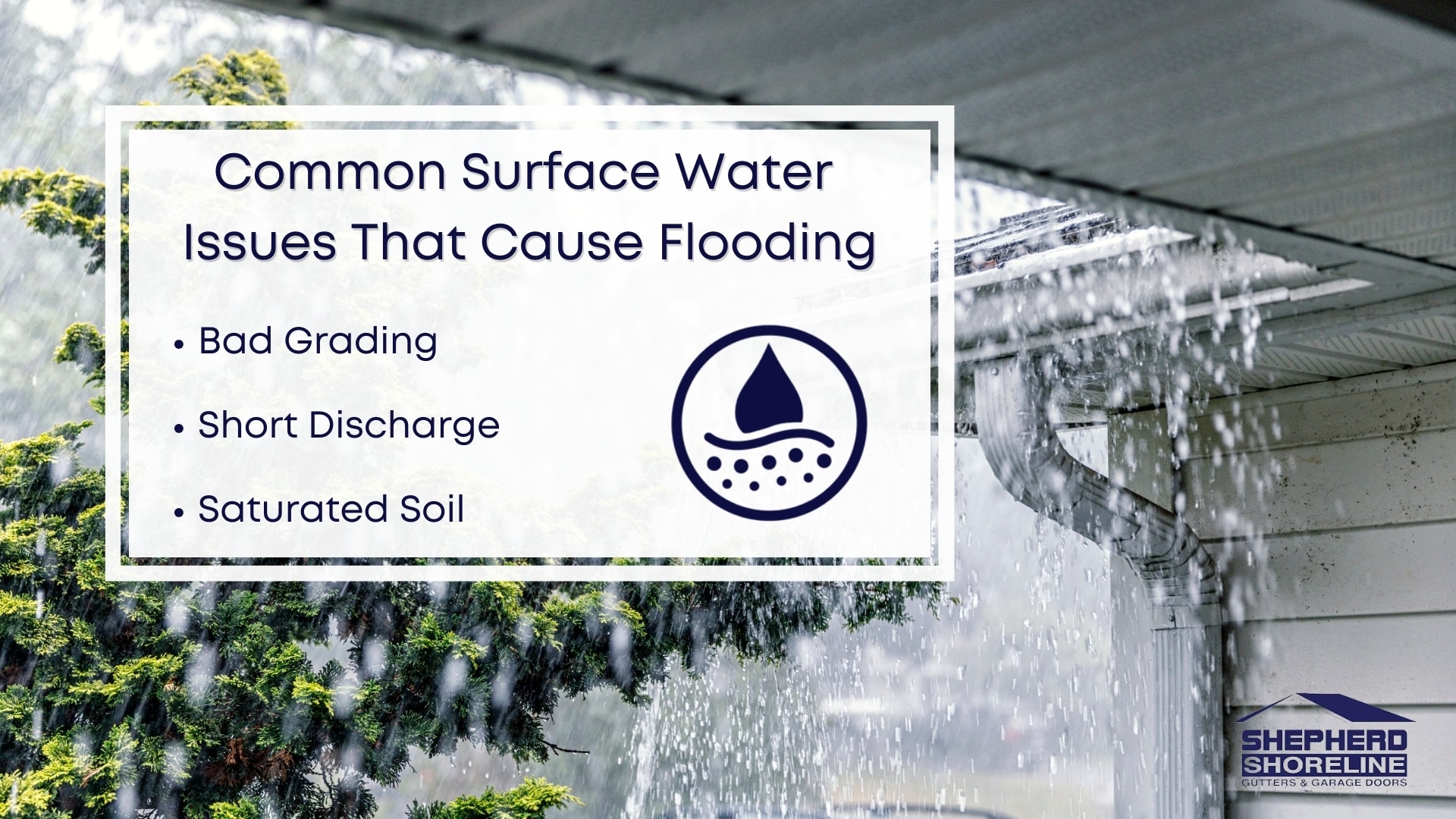
Even when your Coopersville gutters are working properly, surface water can still create serious problems around your foundation. Here are some of the most common surface water issues that cause flooding, even with gutters installed:
Bad Grading
If the ground around your home slopes toward the foundation, even slightly, rainwater naturally runs to the lowest point, which can be your basement wall or the seam where your foundation meets the soil. That steady flow can find tiny cracks, window wells, gaps around utility lines, or weak points in the foundation coating and work its way inside. That’s why the drainage system outside your home matters just as much as what’s happening on the roof.
Short Discharge
Downspouts that empty too close to the house can undo the whole point of having gutters. If the end of the downspout drops water right beside the foundation, or only a foot or two away, you’re basically concentrating a large amount of rain in the exact place you don’t want it. During a heavy storm, a single roof section can send a surprising volume of water down one downspout in a short time. That water can soak the ground next to the wall until it slips inside through cracks or joints.
Saturated Soil
Sometimes the issue isn’t direction, but capacity. Soil can only absorb and move so much water at a time. When the ground is already wet from days of rain, snowmelt, or poor drainage, new rainfall doesn’t soak in easily. Instead, it becomes surface water that spreads outward, pools in low areas, and lingers near the house. Certain soil types, especially heavy clay, hold water longer and drain more slowly. That can leave the ground around your foundation damp for extended periods.
How Subsurface Water Creates Hidden Flooding Problems
While surface water is easy to see, subsurface water works quietly underground. After heavy rain, the soil around your Coopersville home can become saturated. When that happens, water builds up below grade and starts pressing against your foundation. That pressure is called hydrostatic pressure, and over time, it can push water through small cracks in foundation walls, gaps around pipes, or even directly through porous concrete.
Subsurface water problems often show up after long or repeated storms, and you might think your gutters are failing, but the real issue is happening underground. Even a perfectly functioning gutter system can’t stop water that’s already trapped in the soil from pressing inward. If the ground around your home stays saturated for days, that hidden moisture can eventually find its way inside, leading to basement leaks, damp floors, and perhaps musty smells.
Warning Signs Your Flooding Issue Is Not a Gutter Problem
When you’re dealing with water inside your home, it’s natural to blame the gutters first. But sometimes the signs clearly point to something else. Before you invest in another gutter cleaning or even Coopersville gutter repair, take a closer look at where and how the water is showing up.
Wall Seepage
If water is coming through the basement walls or along the joint where the wall meets the floor, that often signals subsurface water pressure. Gutter overflow usually causes visible water near the roofline or pouring over the edges. But seepage through walls suggests water is pushing inward from the soil, and you might notice dark patches or damp streaks forming during or after a storm.
White Stains
Persistent dampness on foundation walls can leave behind a chalky white residue called efflorescence. That happens when water moves through concrete or masonry and leaves mineral deposits behind as it evaporates. Efflorescence doesn’t come from overflowing gutters at the roofline. It forms when moisture repeatedly moves through the foundation itself.
No Overflow
If you don’t see water spilling over the edges, leaking at the elbow or seams, or pouring out of damaged sections, your Coopersville gutters might not be the main problem. When flooding occurs without obvious gutter failure, it usually points to drainage issues at ground level or below it. Poor grading, compacted soil, or a high water table can all allow water to collect and move toward your foundation.
Get a Professional Drainage Assessment From Shepherd Shoreline
If your home keeps flooding even though you have gutters and downspouts in place, it’s time to stop guessing and start getting answers. Let Shepherd Shoreline help you. We can assess your drainage system, identify weak points, and recommend practical solutions tailored to your property. If your gutters are damaged, clogged, or improperly installed, our experienced technicians can provide reliable Coopersville gutter repair to ensure your system is working the way it should. Contact us today at (231) 780-2847 or here to schedule a consultation.