
When heavy rain hits, you expect water to move quickly from your roof, through your gutters, and out through your downspouts without a problem. But sometimes the opposite seems to happen. Instead of flowing away from your home, water seems to push backward, spill out near the downspout, or surge in the wrong direction. That might leave you with overflowing gutters, pooling water near the foundation, and a drainage system that no longer works the way it should.
- What Downspout Backflow Actually Is
- Common Causes of Downspout Backflow
- Warning Signs Homeowners Often Miss
- Fixing Backflow Issues Before They Damage Your Home
Let’s explore what downspout backflow really is, why it happens, and what might be causing it during heavy rain.
What Downspout Backflow Actually Is
Downspout backflow happens when water moving through your gutter system cannot continue flowing away from the home as intended. Instead of exiting freely through the bottom of the downspout or underground drainage, the water meets resistance. Once that happens, it starts to build pressure and move backward, often forcing water up the downspout or back into the gutter above.
Note that backflow is not the same as simple water overflow. Overflow usually happens when water pours over the top edge of the gutter because the volume of rain is too much for the gutter to hold at that moment. True backflow is different. It means water is being blocked or slowed somewhere, causing it to reverse direction and push back into parts of the system that should have already emptied.
Backflow often points to a restriction or design problem in the drainage path. If ignored, it can keep forcing water toward the house instead of away from it. Over time, that can contribute to fascia damage, gutter sagging or separation, and moisture problems around the foundation. In many cases, a careful inspection or timely Muskegon gutter repair can identify the source before the problem gets worse.
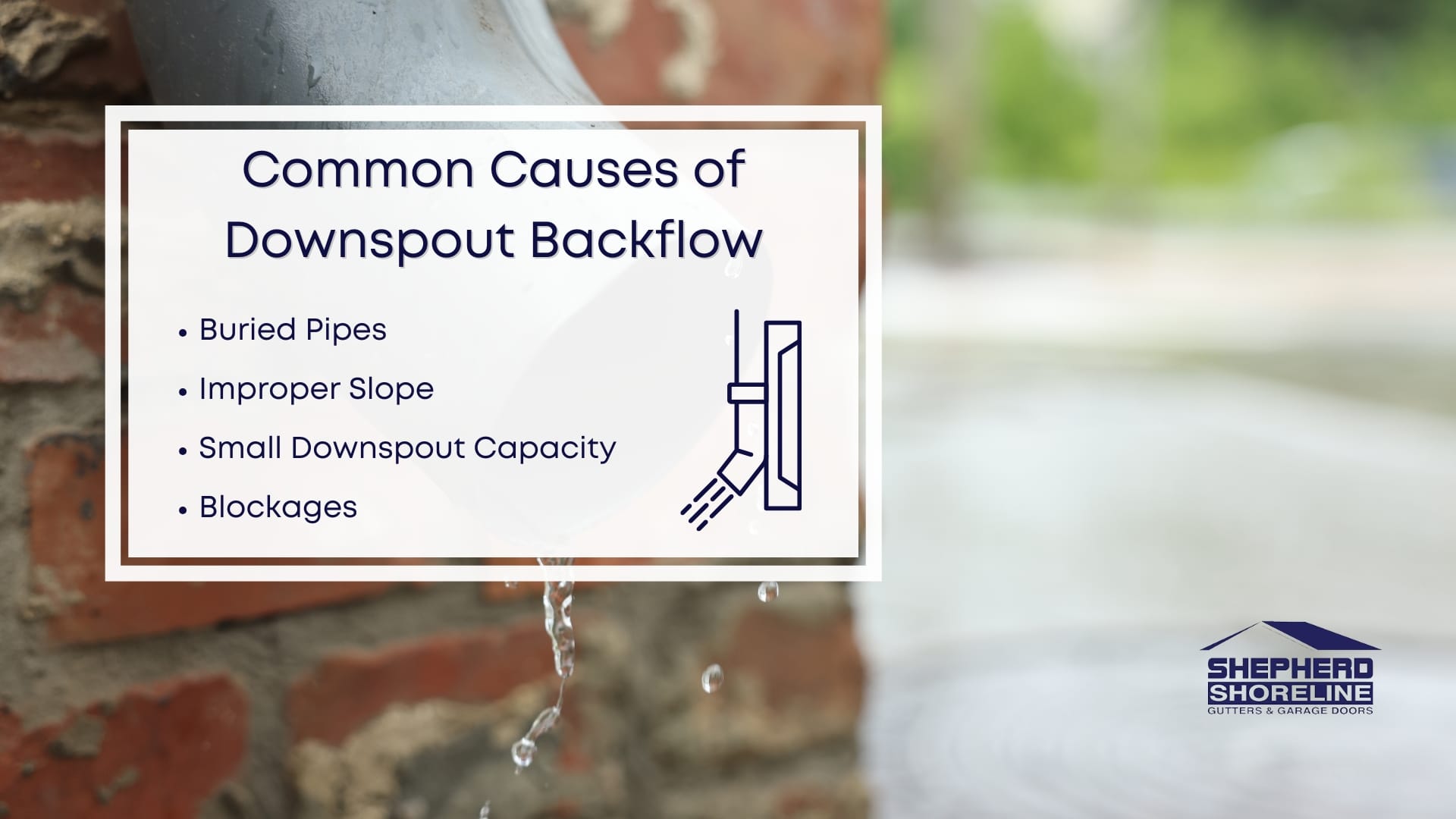
Common Causes of Downspout Backflow
Downspout backflow tends to develop when part of the drainage system cannot keep up with the amount of water coming off the roof. The issue might be a direct blockage or a design flaw that limits flow during storms. In either case, the result is the same: water cannot move forward fast enough, so it begins to back up.
Buried Pipes
Many homes direct water into pipes that run below the ground and carry runoff farther from the house. That setup can work well, but only when the line stays clear. If leaves, roof grit, mud, or other debris collect inside the buried pipe, water loses its path out. During heavy rain, that trapped water has nowhere to go, so it starts pushing back toward the downspout opening.
Improper Slope
Water needs gravity to keep moving. If a buried pipe or extension is too flat or pitched the wrong way, water can slow down or collect in low spots. Once water starts pooling in the line, the system becomes less efficient under pressure. Heavy rain then fills that section faster than it can drain, leading to backup and visible reversal at the downspout.
Small Downspout Capacity
Sometimes the problem starts with undersized downspouts. If the roof collects a large amount of rainwater but the downspouts are too narrow, the system might struggle during major storms. Even without a clog, the water volume can exceed what the downspouts and drains can carry, creating a bottleneck, especially when rain falls fast and continuously.
Blockages
Leaves and twigs might wash into the system from the roof. Dirt and shingle granules can settle inside pipes and gradually reduce the diameter of the drainage path. In underground sections, nearby tree roots can shift or invade lines, especially if joints are weak or older materials are involved. As the space gets narrower, water flow becomes slower and less reliable.
Warning Signs Homeowners Often Miss
Downspout backflow does not always announce itself in an obvious way. In many cases, the warning signs start small and are easy to dismiss as minor storm-related problems. Catching them early can help you avoid more serious water damage later.
Water at Base
During heavy rain, you might notice water pooling right where the downspout meets the ground or see it bubbling up around the connection point. That usually means water is not moving through the drainage line the way it should. Instead of being carried away from your home, it is backing up and forcing its way out at the lowest visible point.
Unusual Sounds
A healthy drainage system should move water quietly and steadily. If you hear bubbling, sucking, or gurgling noises coming from the downspout or underground drain connection, trapped air and water might be struggling to move through a clogged or restricted line. These sounds often happen when water is backing up and pushing against an obstruction.
Wet Soil
After a storm, the soil around your home should gradually dry out, especially if the drainage system is sending water far enough away. If you see soggy soil, muddy areas, or small pools forming near the base of the house, water might be discharging too close to the foundation or reversing direction through the downspout system.
Basement Moisture
If you notice damp walls, a musty smell, wet spots on the floor, or minor seepage after heavy rain, poor exterior drainage might be part of the problem. Water that backs up around the foundation does not always stay outside. Once the ground becomes oversaturated, that moisture can begin to work its way into basement walls or floor joints.
Fixing Backflow Issues Before They Damage Your Home
The good news? Downspout backflow can often be corrected before it leads to major damage. The key is to fix the drainage problem at its source instead of waiting for water to keep finding new ways to escape. Once you identify what is slowing or blocking the flow, you can take steps to improve how the system handles heavy rain.
- Clear Drains
If buried extensions or underground pipes are blocked with dirt, roots, leaves, or sediment, the system cannot move water away properly. In some cases, professional flushing or hydro jetting might restore the line. In others, the pipe might be too damaged or too packed with buildup to save, making replacement the better option. Restoring a clear drainage path helps relieve the pressure that causes water to back up and spill out near the downspout.
- Extend Runoff
Even if water is leaving the downspout, it still needs to be directed far enough away from the house to prevent it from running back toward the foundation. Short extensions or poorly placed outlets can leave water too close to the structure, where it collects in the soil and creates long-term moisture problems. When you extend the discharge point, you give water more room to disperse safely, reducing the risk of recurring saturation around your home.
- Add Capacity
Upgrading downspout size or adding additional outlets might be necessary if your current system is too small for the amount of roof runoff it handles. Large roof sections collect a surprising volume of water during a storm, and undersized downspouts can quickly become overwhelmed. When that happens, water slows down, pressure increases, and backflow becomes more likely. Improving flow capacity helps the system handle heavy rain more effectively.
- Work With a Professional
Working with an experienced Muskegon gutter repair professional is often the smartest way to solve persistent drainage problems. A professional can determine whether the real issue is a hidden blockage, an improper slope, an undersized system, or a poor drainage layout around the home. More importantly, these experts can correct the drainage design in a way that protects your foundation, siding, landscaping, and gutter system from future damage.
If you’re dealing with recurring downspout backflow, Shepherd Shoreline is ready to help. Our competent Muskegon gutter repair professionals can inspect the full system, identify weak points, and provide practical solutions that protect your home from costly water damage. Contact us today at (231) 780-2847 or here to schedule an inspection and get the reliable repairs your home needs before the next heavy rain.